
The last scenes of Revelation are a perfect picture of Advent
"Behold, I am making all things new"
Near the end of the Bible, God speaks from his throne, and his word goes out when he says, "Behold, I am making all things new" (Revelation 21:5). If Advent needed one verse, this would be it.
The word advent simply means "arrival". From its earliest days the church has kept the season with two arrivals in view. There is the first Advent when the Son of God who came in humility at Bethlehem, and then there is the second and final Advent, when same Son who will come again in glory.
Both comings are about newness. The first began the new creation, from the humble manger through the humiliation of death on the cross, and then an empty tomb. The second Advent will make all things new.
We live between those two comings. Our Saviour has been born, has died, has risen and has ascended. Yet the world still groans, our bodies still age, and we still sin. We are a people waiting for the new. That is why the closing chapters of Revelation make such a fitting picture of Advent: they show us exactly what God is making new.
At Reforming we finish our long journey through Revelation over these Advent Sundays. As we do, here are six ways the last scenes of the Bible show us the Advent of all things new.
1. A new creation: promises kept
At Christmas we read the prophets because Jesus fulfilled them. Micah named Bethlehem. Isaiah promised a virgin's son and a child born to us. Every one of those promises came true in the stable.
Revelation 21 shows us that God has more promises still to keep. "Then I saw a new heaven and a new earth" (21:1) is the fulfilment of Isaiah 65:17. This is not God scrapping his world and starting again. It is God renewing what sin has spoiled, as surely as he raised Jesus' own body from the grave. And when the One on the throne has made all things new, he declares, "It is done!" (21:6) — an echo of the cross, where Jesus cried, "It is finished."
The new creation undoes the curse of Genesis 3. No more death, no more mourning, no more crying, no more pain, "for the former things have passed away" (21:4). The God who kept his word at the first Advent will keep it at the second. Christmas is the proof that Revelation 21 is not a fairy tale.
2. A new dwelling: God with us
The heart of Christmas is one name: Immanuel, "God with us" (Matthew 1:23). John puts it this way: "The Word became flesh and dwelt among us" (John 1:14). The word for "dwelt" means "pitched his tent". It reaches back to the tabernacle in the wilderness, where God lived in the middle of his people's camp.
Revelation 21:3 takes that thread and ties it off. A loud voice from the throne announces, "Behold, the dwelling place of God is with man. He will dwell with them, and they will be his people, and God himself will be with them as their God." It is the same tabernacle language, and the same covenant promise God first made to Abraham and Israel. In the new creation there is no temple, "for its temple is the Lord God the Almighty and the Lamb" (21:22).
At the first Advent, God came near for a lifetime in a corner of Judea. At the second, he will come near for ever, across a whole new creation. Immanuel is not only the name of a baby. It is the shape of eternity.
3. A new city: the King comes home
The Christmas story begins in a small town. Joseph went up "to the city of David, which is called Bethlehem" (Luke 2:4), and there the promised Son of David was born. There was no place for them in the inn, and he was laid in a feeding trough.
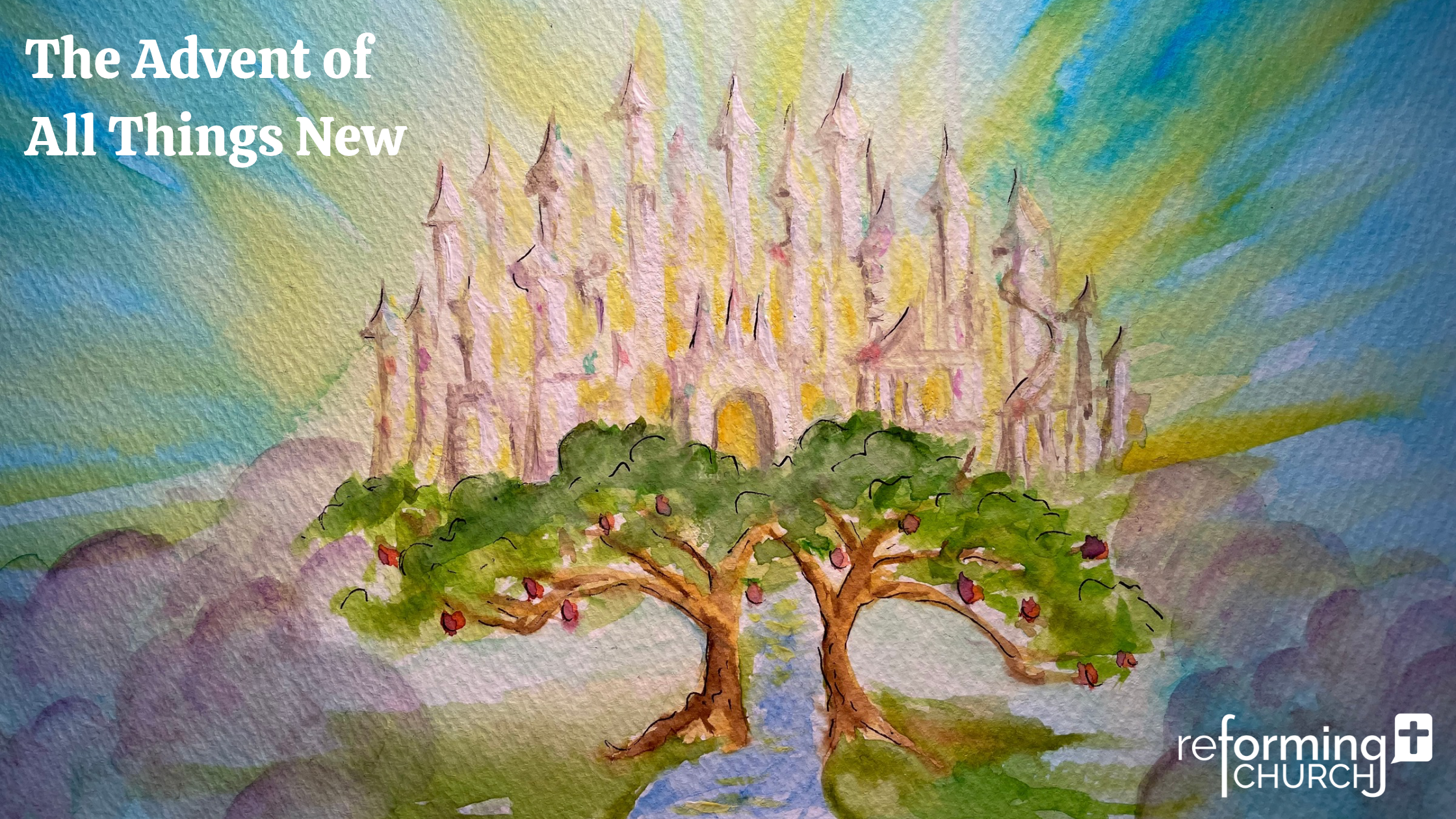
Revelation ends in a very different city. The new Jerusalem comes down out of heaven, "prepared as a bride adorned for her husband" (21:2). It has walls of jasper, gates of pearl and streets of gold (21:18–21). It is the city Abraham looked for, "the city that has foundations, whose designer and builder is God" (Hebrews 11:10). And at its centre is "the throne of God and of the Lamb" (22:1, 3).
Bethlehem had no room for the King. The new Jerusalem has room for all his people, from every nation (21:24–26). Its gates are never shut. The King born in David's city will reign for ever in God's city, and we will reign with him (22:5).
4. A new light: no more night
Advent candles and Christmas lights are not just decoration. They carry a promise: "The people who walked in darkness have seen a great light" (Isaiah 9:2). John's Gospel opens the same way: the true light, which gives light to everyone, was coming into the world (John 1:9).
In the New Jerusalem that light fills everything. "The city has no need of sun or moon to shine on it, for the glory of God gives it light, and its lamp is the Lamb" (Revelation 21:23). "Night will be no more" (22:5).
The light that flickered in a Bethlehem stable will one day blaze across the whole new creation, and the nations will walk by it (21:24). It is not a new sun in the sky but a new source altogether: God himself, shining in the face of the Lamb. So when we light candles at Carols by Candlelight, we are doing more than creating atmosphere. We are confessing that the darkness will not last.
5. A new life: come and drink
Before Jesus came the first time, God sent John the Baptist to prepare the way: "Repent, for the kingdom of heaven is at hand" (Matthew 3:2). Advent has always been a season of preparation as well as celebration, because all things new must include new hearts.
Revelation 21–22 is honest about this. Those who have washed their robes are welcome in the city (22:14). Those who cling to their sin are left outside (21:8; 22:15). Nothing unclean will enter it (21:27). The second Advent will divide humanity, just as Simeon said the first would be for the fall and rising of many (Luke 2:34).
Yet the newness God offers is a gift, not a reward. "To the thirsty I will give from the spring of the water of life without payment" (21:6). Through the middle of the city flows "the river of the water of life" (22:1), and beside it grows the tree of life, last seen at the gates of Eden. The Bible's last invitation is open to anyone: "Let the one who is thirsty come; let the one who desires take the water of life without price" (22:17). Getting ready for Christmas, and for his return, starts there.
6. A new morning: "Come, Lord Jesus"
Israel waited centuries for the Messiah. Simeon was "waiting for the consolation of Israel" (Luke 2:25), and Anna spoke of the child to all who were waiting for redemption (Luke 2:38). Their patience was rewarded in a baby.
We wait too, and the last chapter of the Bible tells us how. The child of Bethlehem speaks from the throne: "I am the root and the descendant of David, the bright morning star" (22:16). The morning star is the last star you see before dawn breaks. Jesus is telling his waiting church that the night is nearly over and a new day is coming. Three times he says, "I am coming soon" (22:7, 12, 20).
So the Bible's last prayer is an Advent prayer. John answers for the whole church: "Amen. Come, Lord Jesus!" (22:20). The early Christians prayed it in one word, Maranatha, "Our Lord, come!" (1 Corinthians 16:22). It was not wishful thinking. It was the settled longing of people who knew the King had already come once, and so were sure he would come again to finish making all things new.
Keeping the Advent of all things new
This year, let's keep Advent with both eyes open. One eye on the manger, where the new creation began and God kept his promise to save us. The other on the throne, where the same Jesus reigns now, and from where he will come to make all things new.
Here are some simple ways to do that this December:
Read the ending with the beginning. Alongside Luke 1–2, read a few verses of Revelation 21–22 each week.
Pray the Bible's last prayer. Add "Come, Lord Jesus" to your grace at meals, or to your family devotions.
Listen to the carols. Many carols look forward to the return of Christ — Isaac Watts based "Joy to the World" on Psalm 98, a song about the Lord coming to judge the earth. Listen for those lines.
Invite someone. The Bride says "Come". Bring a friend to Carols by Candlelight on 24 December in Reforming House.
The Christmas story does not end in the stable. It ends in a new creation: a new city, with God dwelling among his people, the Lamb as its light, the river of life flowing, and every tear wiped away. That is the Advent of all things new, and it is the hope we celebrate this December.
Amen. Come, Lord Jesus!
