
Why have a course, when we don’t rely on a course?
The “Why” of Shepherd Selection Course
Healthy Food for a healthy Household of God: a series of articles and podcasts complementing the sermon series, on the why and how of Reforming.
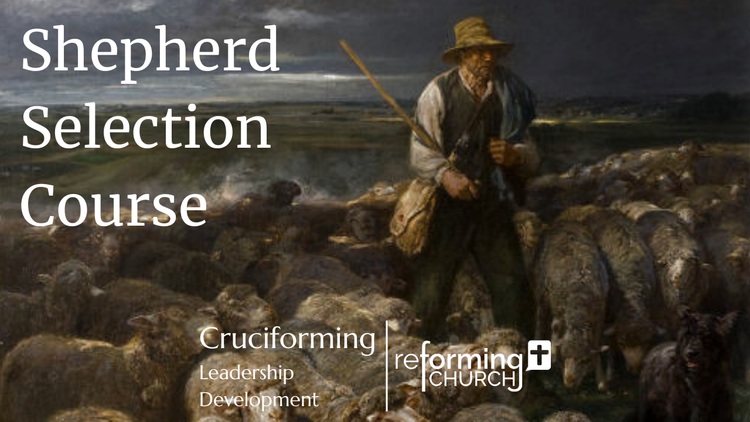
Painting: The Shepherd and His Flock by Charles-Emile Jacque
Why we run a shepherd selection course, and why we don't rely on it to find our elders - because a church will only ever be as healthy as the men who lead it.
‘Presbyterianism’ is leadership, biblically defined. Our church is led by a Session of Elders, and Scripture is clear that the character of those elders is not a side issue for a congregation. It's central to its health.
This is what the apostle Paul is doing in 1st Timothy 3, writing to his younger colleague Timothy, who is pastoring the church in Ephesus. Years earlier, Paul had warned the Ephesian elders themselves that the greatest threat to their church would not come from outside its walls, but from within, from "fierce wolves" teaching false doctrine (Acts 20:29). By the time Paul writes 1 Timothy, that danger has arrived. His answer isn't a strategy document. It's a list of qualifications for the men who will guard the flock.
At Reforming, this list shapes how we think about Eldership Development, including why we run a Shepherd Selection course, and why that course is not and was never meant to be the way we identify future elders.
What Paul Actually Asks For
Read through 1 Timothy 3:2–7 and count the skills. There's really only one: ‘able to teach.’ Everything else: above reproach, self-controlled, respectable, hospitable, gentle, not a lover of money, well thought of by outsiders, is character.
Even that one skill, though, isn't separable from character, and that has a direct bearing on how we go about recognising elders. If the ability to teach is inseparable from character, then no course (however good), can be the primary tool for identifying who is ready to shepherd Christ's sheep. Character can't be certified. It can only be observed, over time, in the ordinary places a man actually lives - his home, his marriage, his friendships, his reputation among people who owe him nothing.
Why We Have a Shepherd Selection Course
None of this makes a course pointless, which is why we run one. A Shepherd Selection course serves a real and limited purpose.
It gives men who are being considered for eldership a shared grounding in Scripture, doctrine, and Presbyterian church government, so they understand what they would be undertaking and why. It meets our denomination's Code requirements, so that the process is orderly and accountable rather than ad hoc. And it gives elders a structured setting in which to test a man's grasp of the faith he would be asked to teach and defend - the one skill Paul does name.
A course is efficient at doing what courses do well - transmitting knowledge and testing comprehension within a fixed period of weeks. That is genuinely useful, and it would be foolish to skip it.
Why We Don't Rely on It to Find Our Elders
But a course cannot do what only time and relationship can do. It cannot tell us whether a man is patient with his own children, faithful and undivided toward his wife, gentle rather than quarrelsome when he's tired or crossed, or well thought of by people outside the church who have no doctrinal stake in flattering him. It cannot tell us whether his teaching, if he has any, actually flows from a changed life - or whether it's polish borrowed for the occasion.
Paul is explicit that this takes time. An elder ‘must not be a recent convert, or he may become puffed up with conceit’ (v.6). Now, this is not because zeal is bad, but because pride can grow just as fast as faith, and it takes a season for the difference to show. There are some growth things that are bad for us.
New growth needs time to weather before it can bear weight. A man can pass every module of a course within a term. Character, by contrast, is proven, not passed.
This is the thinking behind a saying we've found useful:
“The Lord raises up elders,
and the church recognises them."
Recognition is not the same act as selection through assessment. It is a congregation noticing, over years, men whose Christlike character and quiet shepherding of others were already visible before any process began.
Formation Before Selection
Practically, this shapes Eldership Development into two tracks that work together rather than one replacing the other.
The longer, patient track is congregational, where elders and members alike paying attention over time to who is already shepherding people informally, whose home and marriage bear the marks Paul describes, whose reputation holds up under ordinary scrutiny.
The shorter track is the Shepherd Selection course, where equipping and testing the doctrinal, ecclesiological and polity (governmental) knowledge a man will need once that character has already become evident.
The course comes second, not first. It is not the sieve that sifts out future elders from the congregation; it is the classroom for men the congregation has already begun to recognise. Skipping the slow work of formation and treating the course as the whole process would invert Paul's own emphasis - reducing a character list to a curriculum.
Where This Points Us
The deepest reason for all of this is that the qualities Paul lists for elders are simply the character of Christ, the Good Shepherd, who laid down his life for his sheep. Elders are not elite Christians; they are example Christians who are called to display in an office what every believer is called to pursue in the Christian life of integrity in public and in private - when no one but Jesus is watching.
So we keep running the course, because it genuinely helps. And we keep resisting the temptation to let it do more than it can. Reforming needs qualified shepherds, men whose character has already been shaped, patiently, by Christ, long before we ever hand them a course.
