
Reforming’s Company of Preachers
Why and How We Train to Preach Christ
As I come back from some leave over the winter school holidays, I can’t express in enough words just how encouraged I am by the men who have been preaching through the Psalms over the last few weeks. The have shown us Jesus from this the Bible’s songbook, they have preached Christ to our hearts! Thank you Lord for such a company!
Now as we train and develop preachers at Reforming, it has brought another opportunity to reflect on what we’re doing, deliberately. For whilst not all these men are Elders, nor may ever be Elders, there is something theologically practical in application when we see men preaching. For they are not just speaking, as my conviction is that preaching in a church is pastoral preaching, and pastoral preaching is leading.
When preachers teach the word of God and so preach Christ in the Reforming pulpit, they are in that moment leading God’s flock to their Chief Shepherd. They are exerting leadership by teaching and preaching the authoritative word of God. And into this ministry I seek to keep investing in, to keep building such a leadership, such a company of preachers.
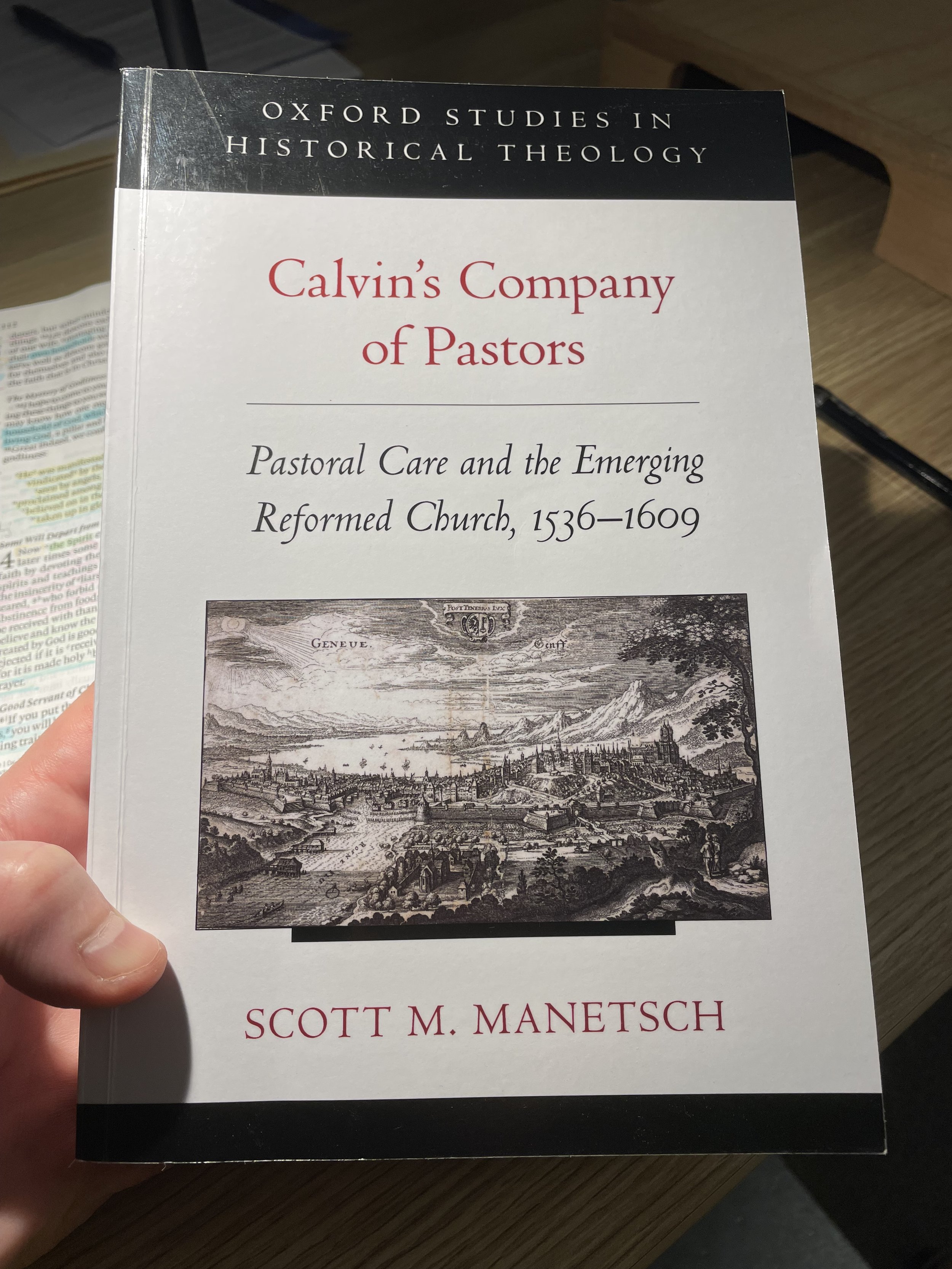
I've been reading this book lately, a realistic read of the ministry of John Calvin and his fellow-preachers and elders in their ministry of reformation at Geneva. It has been informative and inspirational, as much as it has been a gritty description of church-life for that time and place.
And here is one of the things I love about Calvin (among many).
When Calvin came to Geneva, he did not simply preach himself and hope others would copy him. He was intentional, he was deliberate.
Calvin gathered, trained, served with and sent out a Company of Pastors. He was deliberate about seeing men formed together in doctrine, character, and practice, so that the churches of Geneva and beyond would be served by faithful ministers of the Word.
Now as I look at the city of Bendigo, and our region, I see a place in desperate need of reformation. Actual biblical reformation. A recovery of expository preaching, a rediscovery of the doctrines of grace, and a rediscovery of biblical ecclesiology. I personally think that that last one, biblical ecclesiology, is the most neglected in our time and place.
We need not a heretical "new apostolic reformation", but a real biblical reformation. For that to happen I would like to recover that same instinct of Calvin for our own day.
So as Preaching Elder - as the person ordained, called, and responsible for the preaching and public worship at Reforming… I am initiating and instituting Reforming's Company of Preachers.
Why a "Company"
If preaching is pastoral leadership exercised through the Word, then it cannot be learned in isolation, and it cannot be assessed by a single sermon's polish. It must be formed over time, in community, under oversight - in the way character and convictions are formed. This happens under the hand of God slowly, relationally and, under the gaze of others who know you.
This is precisely the genius of Calvin's Company of Pastors.
It was not a lecture series that produced credentialed speakers. It’s not a program that produces preachers out of a cookie cutter pipeline that all sound like [insert your favourite famous preacher here]. For Calvin, and for us, it is a fellowship of men who study Scripture together, encouraging one another in doctrine and life, and are tested in teaching and character before being sent to preach.
For Calvin, preaching was never detached from the pastoral office, and the pastoral office was never detached from a company of fellow-pastors who knew the man, not just his sermons.
Reforming's Company of Preachers seeks to be exactly this kind of company: a group of men being trained together, under the Session, in real relationship, to preach Christ as an expression of pastoral leadership in Christ's church.
How the Company of Preachers Trains Men to Preach Christ
Our training follows a deliberate shape, moving from the who of preaching, to the person doing the preaching, to the what of the text, and to the how of delivery.
Four chapters anchor the course, but each is taught and worked through within the life of the company and not as solo coursework. You can find the online content component of this course over at cruciforming.org.
1. What Is Preaching? (The Who Determines the What)
We begin not with technique but with theology. Drawing on the rich tradition of preaching from Lloyd-Jones and Stott through to Piper, Keller, Robinson, and many others. We ground the course in the biblical pattern of preaching itself: the synagogue pattern of Luke 4 and Acts 13, the apostolic pattern among the early Christians (Acts 18, 20; 1 & 2 Timothy), and the high status Scripture gives to preaching (Romans 10:14; 1 Corinthians 1:21-24; 1 Peter 1:23-25).
Central to this chapter is expository preaching: the conviction that the text determines the message, that preacher and congregation are "on the same page" of Scripture together, and that the sermon flows from an intentional coherence with the text rather than from the preacher's own agenda (Nehemiah 8:8).
We also face honestly the challenges of interpretation. We engage with the problem of historical and moral distance between an ancient text and a modern congregation, and find the solution where Jesus himself found it: in union with Christ, who is the one to whom all Scripture points (Luke 24:27).
In other words, before a man learns how to preach he must be re-formed in what preaching is for. It is not for self-display and self-regard, it is for Christ proclaimed.
2. The Person of the Preacher
The second movement of training turns from the sermon to the man. Working through 1 Corinthians 1–3, the company considers how Scripture both teaches and corrects preachers, shaping them to look more like Christ as they preach Christ.
We train through three lenses:
Conviction: that the Bible is God's Word, where God himself speaks; that prayer is dependence on God's power, not a formality; and that the preacher will be devoted to prayer and the ministry of the Word together, as the apostles were (Acts 6:4).
Character: that godliness is the preacher's pursuit (1 Timothy 4:8), that humility shapes his whole persona (1 Peter 5:5), and that Christlikeness governs how he serves in preaching (Philippians 2:1-11).
Competencies: that preachers are not to be compared on personality or performance, that the whole task of expounding Scripture matters (2 Timothy 3:16-17), and that preachers are leaders even when they are not in the pulpit.
3. Discovering the Author's Purpose (The Big Idea)
With theology and character laid as the foundation, the company moves to the craft of handling a text. Here the emphasis is relentlessly on exegesis, not eisegesis — drawing the message out of the text rather than imposing one onto it.
Trainees learn to meditate on the text of Scripture through repeated, careful reading… "read, read, read again (read or ruin)." They learn detailed exegesis, tracking vocabulary, persons and proper nouns, connecting words, transitions, repeated ideas, and verbs, as well as correlation with other texts.
Context governs everything, because a text without context becomes a pretext for anything and everything unbiblical.
From all of this, trainees learn to distil the author's purpose, the "Big Idea", while asking: “What is the big question this text raises? Why is this text here in the Bible?” Here we also draw on Bryan Chappell's idea of the ‘Fallen Condition Focus’, the way every text addresses something true of fallen humanity that only Christ can answer.
4. Frameworks for Preaching
Finally, the company learns to put all of this into a deliverable shape, using what we call the "Chapman" method. The Big Idea is turned into a question and the sermon is drafted around it:
A prayer of illumination connected to both the text and the people.
An introduction that surfaces the listener's need.
A body of two or three points that follow the text's own movement, each point stated, shown from the text, explained, illustrated, and applied.
A conclusion that aims, in the old Puritan phraseology of “convincing the mind, quicken the will, and move the heart.”
Crucially, this framework is taught and practised within the company where men preach to one another, are heard by one another, and are shaped by one another, just as Calvin's pastors were examined and formed together rather than alone. This for us most of all is done in the church. For the church (and our biblical ecclesiology shapes this) not only is the flock of God - but is the discipleship (and preaching) school of God.
Christ at the Centre, the Church as the Context
Every chapter of this training opens with the same verse: ‘For what we proclaim is not ourselves, but Jesus Christ as Lord, with ourselves as your servants for Jesus' sake’ (2 Corinthians 4:5). Whatever else this training achieves -be that skill in exegesis, competence in delivery, growth in character - if it does not produce men who preach Christ as servants of Christ's church, it has failed.
Just as Calvin understood that Geneva's churches needed not lone voices but a company of pastors, we believe Reforming Church, and the wider Presbytery we serve, is best served not by individuals preaching in isolation, but by a company of men being formed together to preach Christ.
To check out the preaching course that Reforming's Company of Preachers uses, head on over to Cruciforming.org.
