
Why We Need the Psalms
There is a book within the Bible that has been at hand for us and ready to help our hearts through every shade of human experience — from the heights of joy to the valley of death itself. That book is the Psalms.
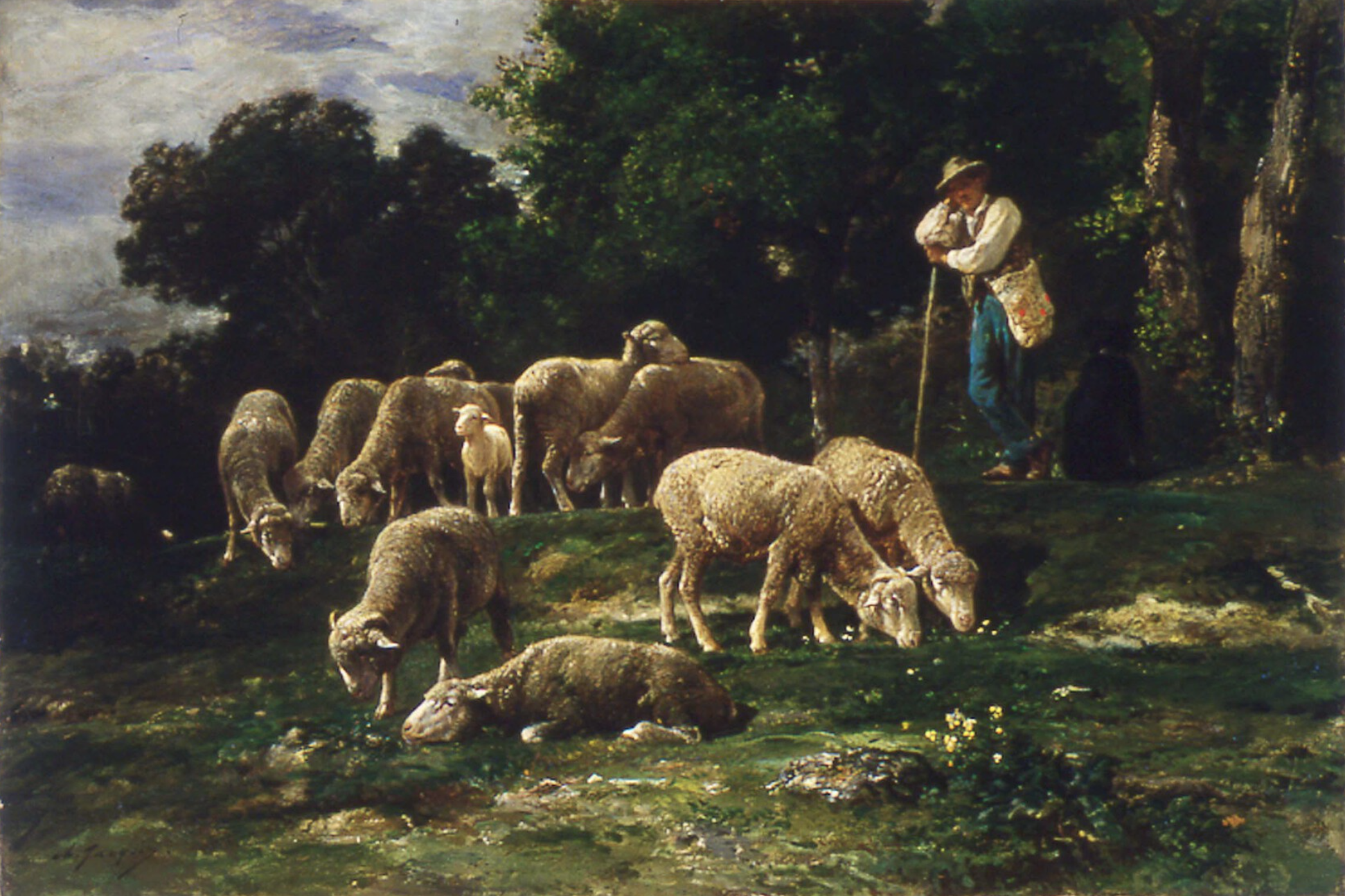
Tending the Flock, by Charles Émile Jacque (1858)
Martin Luther, the continental reformer who changed the course of church history in 1517, called the Psalter "a little Bible, and the summary of the Old Testament." And anyone who has spent time in its pages knows exactly what he meant.
The Psalms don't merely describe life — they enter it. They descend into fear and grief and confusion and come out the other side, not with easy answers, but with something more valuable: an honest voice and a trustworthy God.
In an age that is quick to reach for distraction — for another scroll, another purchase, another form of numbing — the Psalms ask us to sit still with our deepest questions. And they tell us we are not alone in asking them.
A Song for every Sinner and Sufferer - every Believer
The Psalms were written across centuries, by kings and exiles, warriors and worshippers. Psalm 23 — perhaps the most beloved of them all — comes from the hand of David, a man who knew the full arc of human experience. He was a shepherd boy who became a king, a man after God's own heart who also knew betrayal, grief, sin, and the shadow of death.
What David writes in Psalm 23 is not a private poem for private circumstances. It is common to all human experience. The feelings he names — lacking, fearful, in trouble — are feelings that belong to all of us. And the answer he finds is one that reaches across millennia to speak to us still.
That is the genius of the Psalms. They are ancient, yet disarmingly contemporary. They use the language of shepherds and valleys and still waters, and yet they speak directly to a world drowning in wants it cannot satisfy.
The Problem of Want
"The LORD is my shepherd; I shall not want." (Psalm 23:1)
We live in a culture that has turned our feeling of lack into the fuel for consumerism. Advertising, social media, and our consumer society have refined, to a razor's edge, the ability to make us feel inadequate. You lack this. You need that. Your life is incomplete without it. What was once a philosophical question — what makes a good life? — has been answered for us in the language of products and lifestyles and aspirational images.
And so "I want, therefore I am" has quietly become the operating philosophy of modern life.
David wrote his psalm in a different time and plce, and yet he diagnoses the same disease we are all infected with. The feeling of want, he suggests, grows in direct proportion to the size of our desires. The more we chase, the more we lack. The perfect life never matches the picture. we were sold. The dream, once achieved, reveals a new horizon of inadequacy just beyond it.
The Psalms offer a radical alternative — not the suppression of desire, but its redirection. When the Lord is your shepherd, He becomes the way in which all want is satisfied.
David describes being led to green pastures, to still waters, to paths of righteousness. These are images of a deeply contented life — one that has found its rest not in the next thing, but in the presence of the Shepherd himself.
It is worth noting the pastoral honesty of the image. Sheep, in the paddocks of real life, do not often lie down. They are skittish, restless, prone to wandering. But in a good pasture, with a trusted shepherd nearby, they do. They lie down. They are content. He makes me lie down in green pastures — not because the sheep is forced into submission, but because in the presence of this Shepherd, there is nowhere else to want to be.
The Valley We Cannot Avoid
"Even though I walk through the valley of the shadow of death, I will fear no evil, for you are with me." (Psalm 23:4)
Every human culture has tried, in its own way, to avoid the word "death." We dress it up, soften it, push it to the margins of our consciousness or try and refine it. But it doesn't go away. Death casts a long shadow over life — a shadow we feel even on our brightest days, if we're honest.
The Psalms don't look away from death. They walk straight into the valley.
This is one of the things that makes the Psalms so profoundly necessary. Much of our religious and spiritual culture would prefer to stay in the green pastures, to speak only of blessing and abundance. But the Psalms refuse this. They know that the valley is real. They know that each one of us will one day step into eternity, with no way back. The Psalmists know that there is fear in that.
And so Psalm 23 does not tell us the valley is an illusion, or that if we have enough faith we won't have to walk through it. It says: even though you walk through it — you will fear no evil. Not because the valley is made safe, but because you are with me.
The shift in language at this point in the psalm is quietly astonishing. For the first three verses, David speaks of the Lord in the third person: He makes me lie down, He restores my soul, He leads me. But in verse 4, as the shadow falls and the valley deepens, the language becomes intimate: you are with me. In the moments of greatest fear, our Lord and God is real and personal, by His Spirit, with real personal presence. As Jesus says, He is with us to the end of the age.
This is the pastoral heart of the Psalms. They do not offer us arguments. They offer us a companion. And in the shadow of death, this is what we need most.
The Table in the Wilderness
"You prepare a table before me in the presence of my enemies." (Psalm 23:5)
There is a phrase in the psalm that, on close inspection, turns out to be almost defiantly joyful. The Lord prepares a feast — not after the enemies are gone, not in some future golden age when all troubles are resolved — but in their presence. Now. In the middle of the mess.
The Psalms are full of this tension. They don't promise the absence of trouble. They promise the presence of God in the middle of it. Contentment is not on the far side of suffering; it is available in the thick of it.
"My cup overflows," David writes. It is the declaration of someone who has discovered that the Lord's abundance is not dependent on circumstances. For those who walked into the Psalms as glass-half-empty people, this is a radical transformation — not a natural one, but a supernatural one, worked by God.
This is why the Psalms remain so vital. They don't offer wishful thinking or theological optimism. They have been tested in the furnace of real human experience — grief, exile, persecution, doubt, betrayal — and they have come out with this stubborn, joyful, honest confession: Surely goodness and mercy shall follow me all the days of my life.
The Shepherd Who Died
The Psalms are not simply the poetry of a people who believed in a distant, powerful God. They are the expression of a relationship — intimate and personal. And in the New Testament, the identity of this Shepherd becomes fully clear.
Jesus, in John 10, says: "I am the good shepherd. The good shepherd lays down his life for the sheep." He is not merely the Shepherd who walks with us through the valley. He is the Shepherd who descended into the valley himself — who faced death, who bore the full weight of human sin, and who came out the other side in resurrection.
This is the central drama that the Psalms, in all their variety and rawness, are pointing toward. When David writes of a Shepherd who restores the soul, who is present in the valley, who hosts a table in the wilderness — he is painting a portrait whose full colours are only revealed in Christ. The Lamb who is also the Shepherd. The one who knows what it is to suffer because he himself has suffered. The one who offers not merely sympathy, but solidarity and salvation.
Why We Still Need Them
It would be easy to think of the Psalms as ancient religious literature — valuable in their way, but distant from the pressures and confusions of contemporary life. That would be a mistake.
We need the Psalms because we still feel lack, and the world’s answer to that lack is that it will never finally satisfied. But Jesus surpasses all that the world offers, and He is all satisfying.
We need the Psalms because death still casts its shadow, and our culture's best response — distraction, denial, staying busy — is not enough when the valley actually comes. We need the Psalms because we are, all of us, prone to wander off the paths of righteousness, pulled by our own desires into our own small stories, and we need a voice that calls us back.
We need the Psalms because they are honest in a way that much of our life is not. The Psalms cry out., they complain, they grieve. They ask hard questions of God. And then — remarkably, consistently, and not without difficulty — they arrive at trust.
Luther was right. The Psalms are a little Bible. They hold the full sweep of the human story and the divine response to it. They tell us we are not alone in our lack, our fearing, our trembling before the shadow of death. And they tell us that the one who made us has come to walk with us — through the valley, to the table, and all the way home.
"I shall dwell in the house of the LORD forever." (Psalm 23:6)
That is not wishful thinking. For those who have found their shepherd in Christ, it is a promise guaranteed by God himself.
(Article developed from a sermon on Psalm 23 preached at Reforming Church in October 2023)
